52% of Small Businesses Already Use AI: Where to Start
Sebrae reports 52% of Brazilian small businesses have used AI. What the study shows, who uses it most, and how to start without wasting time.
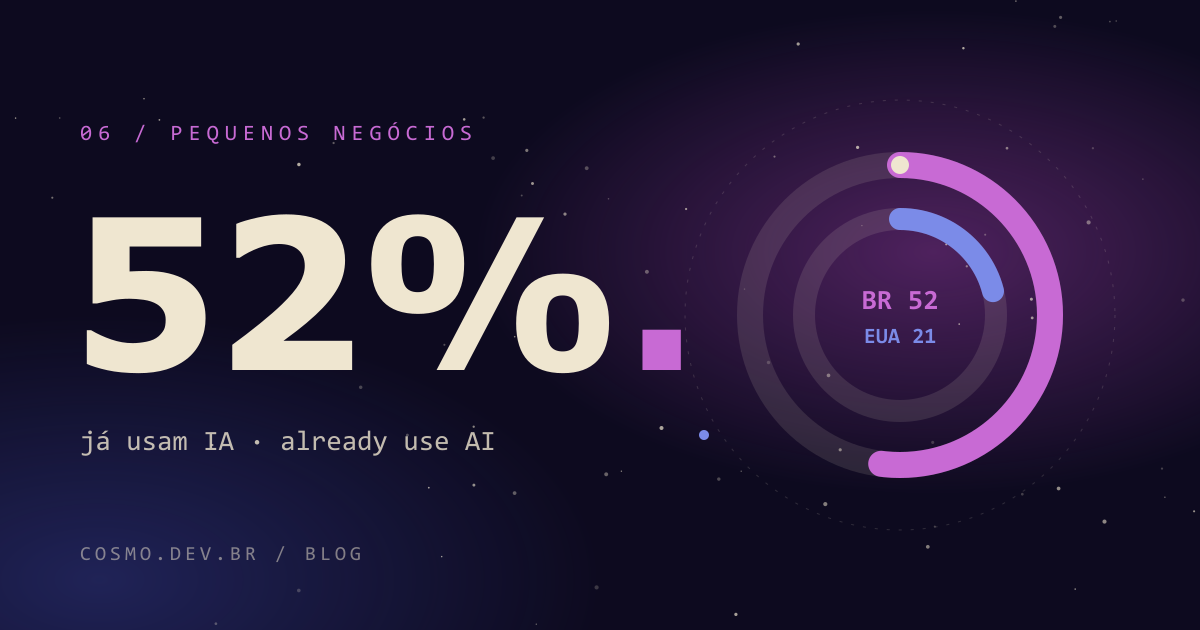
“Is AI worth using in my business?” already has a practical answer: more than half of Brazilian small business owners say they have used it. The question left is where to start without wasting money or time.
The numbers below come from the Transformação Digital nos Pequenos Negócios (2026) study, run by Sebrae with Meta Instituto de Pesquisa and released in August, as reported by Agência Sebrae (in Portuguese). I separate what the study says from my own reading.
What the study found
The survey interviewed 7,182 owners of micro-entrepreneurs, micro and small businesses, between 24 March and 8 May 2026.
| Indicator | Brazil | US |
|---|---|---|
| Used AI in the previous two weeks | 52% | 21% |
| Plans to adopt or expand use next semester | 60% | 24% |
| Had to create new workflows | 46% | 15% |
US figures come from the Census Bureau’s BTOS survey, which Sebrae used as a reference. Because questions and populations differ, read the comparison as an order of magnitude.
Who uses it most
According to the same release, use is higher in some groups:
- Small businesses (EPP): 61%.
- Services sector: 62%.
- Owners aged 18 to 29: 78%.
- Owners with a postgraduate degree: 75%.
My reading: businesses that sell time, support and knowledge, as services do, feel the gain most from an assistant that drafts, summarizes and replies.
What businesses use it for
In the Sebrae and Meta Instituto de Pesquisa study, the most common use is improving tasks employees already did (28%), followed by creating new roles (19%). AI mostly shows up as reinforcement, not replacement.
A separate survey by Sebrae and FGV IBRE (December 2025) found 59% of micro and small businesses use AI for marketing and promotion and 30% for data analysis, according to UAI Notícias (in Portuguese). They are different surveys, so do not add the numbers together.
What about jobs?
Among businesses using AI, 90% did not change headcount in the previous six months. 5% cut positions because of AI and 3% hired more because of it.
Why almost half still do not use it
Among those who do not plan to use AI in the next six months, 38% say they do not know what the technology can do. In the US, the most common answer is different: 62% say AI “does not apply to the business”.
That changes the diagnosis. In Brazil the barrier is not thinking AI is useless, it is not knowing what it could do for your day-to-day. Concrete examples fix that, enthusiasm does not.
One easy-to-miss figure: 46% of Brazilian businesses had to create new workflows, against 15% in the US. My reading is that AI is rarely “install and use”: it almost always asks you to adjust the process around it.
Where to start
This part is my opinion, from what I see in projects. It is not from the study.
1. Pick one task
Repetitive, frequent and easy to measure. Good candidates: answering the same customer questions, drafting a first quote, summarizing meetings, preparing a first version of a text.
2. Measure first
Note how long the task takes per week today. Without that number, in a month you will only have an impression.
3. Keep a person reviewing
AI drafts, a person checks before it reaches the customer. Over time you learn where you can trust it more.
4. Protect customer data
Before pasting names, phone numbers or documents into any tool, understand how it handles that data. If it is unclear, test with fictional or anonymized information.
5. Connect AI to what you already use
AI sitting in a browser tab becomes copy and paste. Connected to your spreadsheet, your system or your WhatsApp, it becomes a process: information arrives on its own and the answer lands in the right place. That is usually where the big gain is, and also the process adjustment the study points to.
6. Review in 30 days
Compare with the number from step 2 and decide: keep, adjust or drop. Dropping is also a result.
When it makes sense to ask for help
When the idea is clear but depends on connecting systems, when customer data needs care, or when you want to get the first workflow right without months of trial. That is why I built the applied AI and automation services.
Checklist
- One repetitive task chosen
- Current weekly time noted
- A person responsible for reviewing the AI output
- A clear rule on which customer data may enter the tool
- A plan to connect AI to the systems the company already uses
- A date set to review, 30 days later
Want to find where AI would start paying off in your business? Let’s talk.
Frequently asked questions
Does the 52% apply to every company?
No. The sample was 7,182 owners of micro-entrepreneurs, micro and small businesses, asked whether they had used any AI tool in the two weeks before the interview. It is self-reported, not a measurement of what each company actually does.
Can I compare the 52% with the 21% in the United States?
Sebrae made that comparison itself, using the Census Bureau’s BTOS survey as the reference. Different surveys ask different questions of different populations, so read it as an order of magnitude, not an exact scoreboard.
Will AI reduce headcount?
In the study, 90% of businesses using AI did not change headcount in the previous six months, 5% reduced it and 3% hired more because of AI. That describes what already happened; it does not predict your business.
I have never used AI in my business. Where do I start?
Pick one repetitive task you can measure, such as answering the same customer questions or drafting a first quote. Note how long it takes today, use AI for the draft, review it yourself, and compare after a month.