An AI-ready website: llms.txt, crawlers in robots.txt and structured data
The technical side of optimizing for AI: which crawlers exist and what each one does, how to decide what to block, what llms.txt is and how structured data helps models understand your site.
The two previous articles covered technical SEO and how to write to be cited. This one closes the series with the infrastructure: what needs to be on the server so AI systems can access, understand and cite your site.
Who the AI crawlers are
Each company runs more than one crawler, with different jobs. The main ones, according to each company’s documentation:
| Company | User-agent | Purpose |
|---|---|---|
| OpenAI | GPTBot | Collection for model training |
| OpenAI | OAI-SearchBot | ChatGPT search index |
| OpenAI | ChatGPT-User | Visits made on a user’s request |
| Anthropic | ClaudeBot | Collection for model training |
| Anthropic | Claude-SearchBot | Claude search |
| Anthropic | Claude-User | Visits made on a user’s request |
| Perplexity | PerplexityBot | Perplexity search index |
Google-Extended | Control token for use in Gemini (not a separate crawler) | |
| Apple | Applebot-Extended | Control token for training use |
| Common Crawl | CCBot | Open dataset used by many models |
The distinction that matters is training vs. search. Blocking training is a decision about how your content is used; blocking search means giving up on being cited.
robots.txt: decide and declare
For a portfolio or services site, where being found is the goal, I allow search crawlers and make the training decision explicit:
# AI search: allowed (we want to be cited)
User-agent: OAI-SearchBot
User-agent: Claude-SearchBot
User-agent: PerplexityBot
Allow: /

# Training: the site owner's call
User-agent: GPTBot
User-agent: ClaudeBot
User-agent: Google-Extended
User-agent: CCBot
Allow: /

# Everyone else
User-agent: *
Allow: /

Sitemap: https://dominio.com.br/sitemap.xml
Switch Allow to Disallow in the second block if you do not want your content used for training. Two notes:
- robots.txt is a request, not a lock. Major companies state they honor it, but it is not access control.
- User-triggered agents (
ChatGPT-User,Claude-User) follow their own rules, described in each company’s documentation.
Cloudflare: the block you did not turn on
If your site goes through Cloudflare, open the dashboard. Since July 2025 Cloudflare has offered, and enabled by default on new domains, AI crawler blocking. It is good protection if you do not want to be scraped, but it can silently remove your site from AI search answers. Check Security → Bots and align it with your robots.txt.
HTML a crawler can read
AI crawlers generally do not execute JavaScript. They download the HTML and extract the text. To them, an SPA that builds its content in the browser is an empty page.
What I make sure of:
- Pre-rendered content (SSG or SSR). All text must be in the final HTML.
- Semantic HTML:
<article>,<nav>,<main>, ordered headings, real lists, tables with<th>. - Nothing important inside images. Text in images is not read; use descriptive
altwhen an image carries information. - Fast server responses. Crawlers have timeouts; slow pages get dropped.
llms.txt: a site map for models
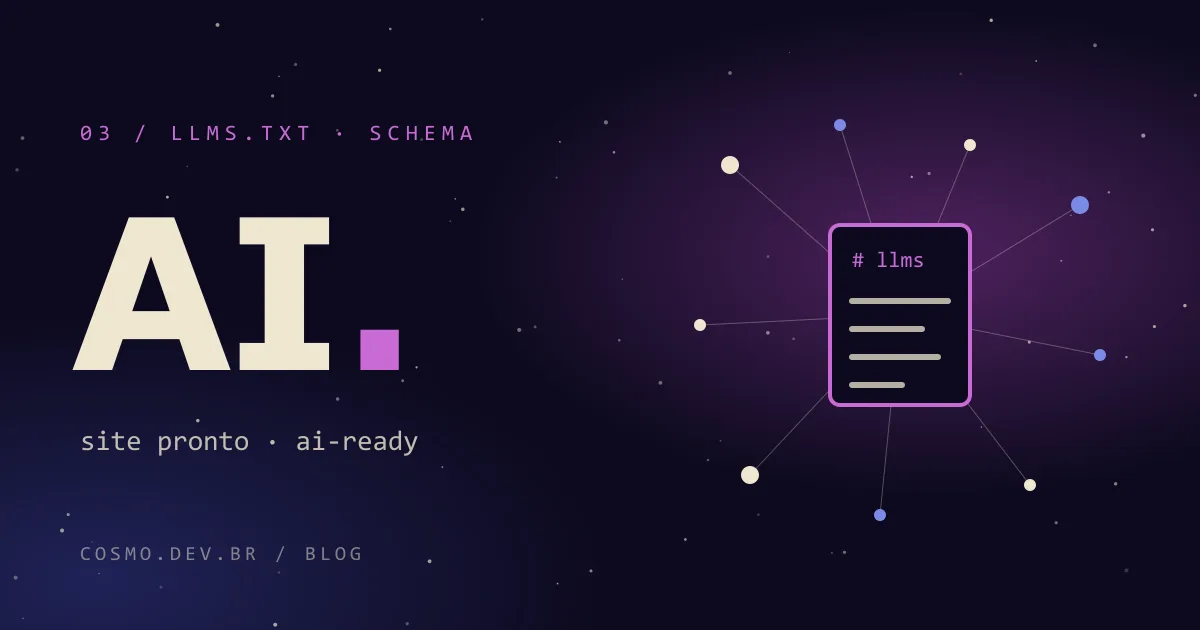
llms.txt is a September 2024 proposal by Jeremy Howard (llmstxt.org): a Markdown file at the site root with the project name, a summary and links to the pages that matter. The idea is to give a model, in a single read, the context it would otherwise need dozens of pages to build.
To be honest about where things stand: no major AI provider has publicly committed to reading llms.txt for search or ranking. Where it already helps is with agents, coding assistants and tools that build context from documentation. Since the cost is close to zero, I publish one.
The format is simple:
# Adryan Cosmo

> Full-stack web developer. Websites and digital products
> with applied AI.

## Articles

- [Technical SEO in 2026](https://dominio.com.br/en/blog/seo-tecnico-checklist/): crawling, indexing and Core Web Vitals checklist
- [GEO](https://dominio.com.br/en/blog/geo-motores-generativos/): how to get cited by generative engines

## Projects

- [MindUni](https://github.com/CosmoAdryan/minduni): mental health app for university students
On this site, the file is generated at build time from the articles and projects themselves, so it never goes stale. You can see the result at /llms.txt.
Structured data: what to state explicitly
Models try to answer “who said this, when and with what authority?”. JSON-LD answers without ambiguity. The minimum I publish:
Person(orOrganization) on every page, withname,jobTitle,url,knowsAboutandsameAspointing to GitHub and LinkedIn. That is what ties the site to your other profiles.BlogPostingon each article, withheadline,author,datePublished,dateModified,imageandinLanguage.BreadcrumbListto show where the page sits in the site hierarchy.FAQPagewhen the content has real questions and answers.
{
  "@context": "https://schema.org",
  "@type": "BlogPosting",
  "headline": "An AI-ready website: llms.txt, crawlers in robots.txt and structured data",
  "author": { "@type": "Person", "name": "Adryan Cosmo", "url": "https://dominio.com.br" },
  "datePublished": "2026-10-14T00:00:00.000Z",
  "dateModified": "2026-10-14T00:00:00.000Z",
  "inLanguage": "en"
}
Validate with Google’s Rich Results Test and the schema.org validator.
AI-ready site checklist
- AI search crawlers allowed in
robots.txt - Decision on training crawlers made and declared
- Cloudflare (or CDN) bot rules aligned with
robots.txt - Main content in server HTML, not dependent on JavaScript
- Semantic HTML, ordered headings, nothing important only inside images
-
/llms.txtgenerated at build time -
PersonJSON-LD withsameAsandBlogPostingwith dates - Takeaways and FAQ on key content (GEO techniques)
None of this is magic, and none of it replaces good content. But it is the difference between a site AI can read and cite and one it simply does not see.
Frequently asked questions
Does blocking GPTBot remove my site from ChatGPT?
Not necessarily. GPTBot collects data for training. ChatGPT search uses OAI-SearchBot. If you block only GPTBot, your content stays out of future training but can still appear and be cited in search.
Does llms.txt improve my ranking?
There is no evidence it improves search rankings, and no major AI provider has publicly committed to using it. It is useful as a clean map of the site for agents, coding tools and anyone assembling context manually.
Does Google-Extended block AI Overviews?
No. Google-Extended controls whether content is used to train and ground Gemini models outside Search. AI features in Search use Googlebot and follow the same snippet controls as regular search, such as nosnippet.
Do I need Markdown versions of my pages?
It is not required. Semantic, pre-rendered HTML is already read well by models. Markdown versions mostly help technical documentation, where agents copy code snippets.