AI in Basic Education Published
Eight modules for teachers to use AI in class safely.
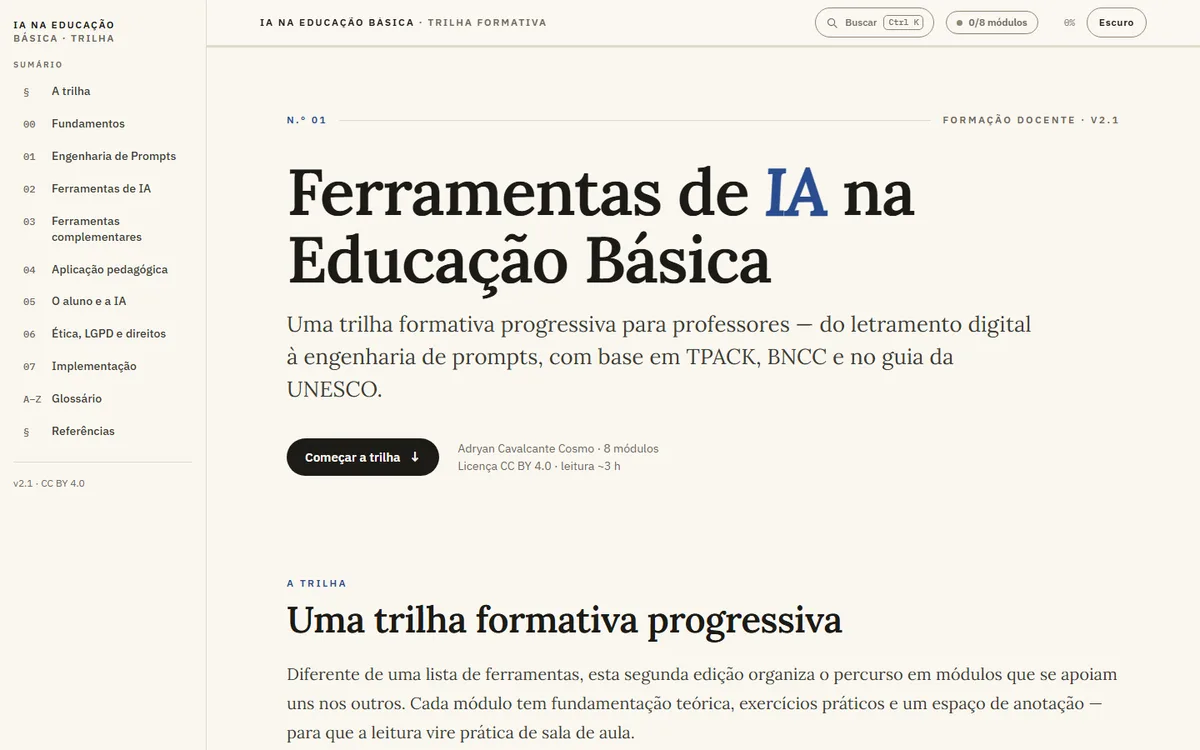
A progressive path, from digital literacy to prompt engineering, that gives teachers something to apply in tomorrow's class, grounded in TPACK, Brazil's BNCC and UNESCO guidance. Open and free. Content in Portuguese.
Also: Ebook v1 (opens in a new tab) GitHub (opens in a new tab)
Project facts
- Role
- Author, design and development
- Year
- 2025–2026
- Status
- Published · v2
- License
- CC BY 4.0
01 / The problem
AI reached schools before teacher training did
Students already use AI, and teachers have to decide what to do about it — usually on their own. What is available tends to be lists of trendy tools or overly technical texts, disconnected from the curriculum and silent on ethics and privacy.
What was missing was a step-by-step path, in Portuguese, starting from the basics, reaching classroom practice and taking student data, copyright and the student's role seriously.
02 / The solution
A step-by-step path, from concept to classroom
The path is the second edition of the AI & Education ebook. Instead of a list of tools, it organizes the content into eight modules that build on each other, so teachers can move at their own pace:
- Foundations
- Prompt Engineering
- AI Tools
- Complementary tools
- Teaching practice
- The student and AI
- Ethics, data protection and rights
- Implementation
Built for people short on time
Teachers read between classes. That is why the path loads fast, works well on phones, saves progress and has keyboard search. The table of contents is always in view, and each module shows where the teacher is along the way.
Truly open
The content is licensed under CC BY 4.0 and the code is public. An education department can adapt the material for its own schools, and a trainer can use it in workshops without asking for permission — all it takes is crediting the source.
03 / Features
What the product delivers
-
Eight progressive modules
Foundations, prompt engineering, tools, teaching practice, the student and AI, ethics and implementation, each one building on the last.
-
Theory that becomes practice
Every module combines background, hands-on exercises and room for notes, so reading turns into a lesson plan.
-
Instant search
A Ctrl K shortcut to find any concept, tool or term in the path without losing your place.
-
Saved progress
A completed-modules counter follows the teacher, who can stop and resume whenever there is time.
-
Glossary and references
Technical terms explained in plain language, and sources gathered for anyone who wants to go deeper.
-
Dark mode and print version
Comfortable reading at night and a print-ready version for in-person training or studying on paper.
04 / Technology
Technical choices, and why
- Front-end
-
- HTML
- CSS
- JavaScript
No framework: lightweight pages that load fast even on weak school connections and can be hosted anywhere for years.
- Teaching framework
-
- TPACK
- BNCC
- UNESCO guidance
TPACK connects technology, pedagogy and content; the BNCC anchors it in the Brazilian curriculum; UNESCO guidance frames the ethical use of generative AI.
- License
-
- CC BY 4.0
An Open Educational Resource: school networks and trainers can copy, adapt and redistribute it, as long as they credit the author.
05 / By the numbers
The product in numbers
- 8modules
- ~3 hof reading
- 3teaching frameworks
- 2published editions
06 / Limits and ethics
Safeguards the path teaches
Ethics is not an appendix: it has a full module and runs through all the others.
- Do not put students' personal data into AI tools without a legal basis and a real need.
- Treat AI output as a draft to check, never as the final source.
- Teach students to use AI to learn, not to outsource their thinking.
Next mission
Need a content platform or an online course?
Teaching material, training path or content site: I turn your material into a digital experience that is organized, accessible and easy to navigate.